
In last week’s blog, we covered the federal government’s initial review and criteria for deciding which projects qualify to be designated as projects of national interest (major projects) under the Building Canada Act (BCA). This initial review is the first of several steps in the BCA process.
In today’s blog, we break down Step 2 of the BCA process: how the Major Projects Office (MPO) assesses major projects for listing (or not) under the BCA. Read on to learn more!
Also, don't forget to sign up for our FREE webinar on November 18th. In the webinar, our regulatory advisors will walk you through the Building Canada Act and what it means for Indigenous Nations. They will explore practical ways your Nation can navigate these processes strategically, protect your rights, interests, and territories, and pursue stronger outcomes that advance the prosperity and well-being of your community and citizens.
Register for our free webinar here:
How to Navigate Major Projects: A Guide for Indigenous Nations
The Major Project's Office Process
The MPO is a “special operating agency” within the federal government, reporting directly to the Privy Council Office. The MPO assesses proposed major projects, coordinates reviews with other government agencies, and provides advice to federal decision-makers about major projects.
Today we break down Step 2 of the BCA process: how the MPO assesses major projects for listing (or not) under the BCA.
The MPO’s process involves two main elements:
- A more detailed national interest assessment—a deeper evaluation of whether a project meets the BCA’s national interest criteria.
- Detailed review and consultation with affected Indigenous Peoples, other federal government agencies, and other levels of government (provincial, territorial).
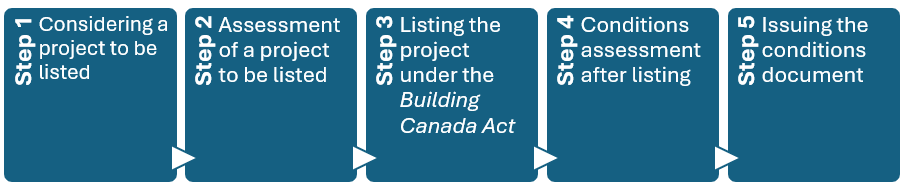
|
If a project proposal meets the BCA criteria and is sufficiently advanced[SM1] , Canada refers it to the Major Projects Office (MPO). |
The MPO conducts Crown Consultation on whether to list the project under the BCA with affected Indigenous Peoples and other levels of government. The MPO then issues recommendations to the federal Cabinet.[1] |
The Cabinet decides whether to list the project under Schedule 1 of the BCA. This includes a 30-day consultation notice in the Canada Gazette. If the project is listed, all assessments and permits are deemed to be complete and granted, subject to Step 4. |
Federal review to develop specific technical conditions and mitigation measures. If an impact assessment is required, the proponent submits an Impact Statement. Indigenous consultation is focused on conditions and mitigation measures. |
The Minister of One Canadian Economy issues a single set of binding conditions for the project. |
[1] This process diagram is based on Government of Canada information- https://www.canada.ca/en/one-canadian-economy/services/building-canada-act-projects-national-interest.html
[1] Also referred to as Governor-in-Council.
National interest assessment
When Canada refers a project to the MPO, the Office conducts a detailed, in-depth review of available information to determine whether it meets the national interest criteria under the BCA, evaluating:
- The project’s potential economic benefits and likelihood of successful delivery
- How it supports Canada’s security, resilience, and economic independence
- Whether it advances Indigenous interests
- Its contribution to clean growth and climate objectives
Projects that align with these priorities move to the next stage of review
Detailed review and consultation
Next, the MPO completes a detailed evaluation of whether the project—and/or the federal government decision to list the project—will adversely affect:
- Indigenous Nations, territories, rights, and interests
- Relevant federal ministers/departments
- Provincial and territorial governments
This stage is important for Indigenous Nations: it provides one of the best opportunities in the BCA process, at the broadest scope, to identify potential impacts on rights, lands, resources, and cultural values—before the MPO makes key decisions associated with listing the project under the BCA. Canada has specifically said it “will only make a decision to list a project under the Building Canada Act after [it] has met its duty to consult with Indigenous rights holders.”[1] However, in our experience with this process so far, the MPO will scope its requirements for consultation to the decision to list the project under the BCA.
How can Nations engage in this step of the process?
The BCA process has flipped our previous experience of development
decision-making and consultation on its head.
Without being fully informed by an impact or environmental assessment— and without the time required to come to terms on accommodation and long-term relationship agreements with proponents—our clients our now being asked to provide input to decisions that may have far-reaching effects on their rights, lands, and communities.
[1] Detailed information under step 2 in https://www.canada.ca/en/one-canadian-economy/services/building-canada-act-projects-national-interest.html
The listing of a project under the BCA equals a full approval and set of federal permits, subject to a narrow, “technical” list of conditions developed in a later step in the process. Despite this reality, there are measures you can take to strengthen your position at this stage of the process:
- Keep informed about major projects that may be coming your way, and learn from others about how they are experiencing and responding to the BCA process
- Share key information about your lands, community, culture and laws, your cultural and land-use values, and the impacts of past and current projects on your rights and territory. This information is a basis for demonstrating potential project impacts. Work with MPO staff to ensure that sensitive information will be kept confidential
- Request details about the MPO’s review timeline. If necessary, seek an extension as soon as possible, to gain time to gather information from citizens or staff, , and make informed decisions.
- Engage the project proponent (if this is not yet in progress): Seek a defined process for consultation and accommodation of impacts, including capacity funding for your involvement and measures to protect any information your Nation shares.
- Consider what and who you will need for your team to engage effectively throughout the process—whether this be leadership, staff, Elders, Knowledge Holders, advisors, or legal counsel.
Our complete Information Blog Series:
Missed a post? Find all of our Major Projects Readiness blog posts here:
- MAJOR PROJECT AND TIGHT TIMELINES- ARE YOU READY?
- Major Projects and Tight Timelines- How to Pick a Consultant That's Right for You
- The Building Canada Act- What Indigenous Nations Need to Know
- The Building Canada Act- How are Projects Designated under the Act
-
The Building Canada Act: What Indigenous Nations Need to Know About the New Assessment Requirements
Concerned about your Nation’s readiness to deal with streamlined project approvals?
Shared Value Solutions can help
If you need support, we are here to help! Contact us at info@sharedvaluesolutions.com / 226-706-8888 for more information.
SVS Regulatory Advisors:

Scott Mackay MSc, RPP
Partner and Senior Consultant
Learn more about Scott here.

Meaghan Luis, MSc Pl RPP
Senior Environmental Impact and Negotiations Specialist
Learn more about Meaghan here.

Meghan Dalrymple, MA
Senior Environmental Impact Specialist
Learn more about Meghan here.
Download our Free eBook:
Looking for more information on how to manage requests coming into your Lands and Consultation Department? Check out our Lands and Consultation Guidebook below:
