
At SVS, we have been watching the pendulum swing on federal impact assessment law and policy for the last 14 years—ever since our company was founded. From the Harper Conservatives’ curtailing of the Canadian Environmental Assessment Act in 2012, to the review and reform process under the Trudeau liberals that culminated in the current Impact Assessment Act of 2019, to the present-day rollback of impact assessment requirements for major projects under Prime Minister Mark Carney.
Now federal impact assessment change is accelerating again. The engagement period for the latest discussion paper and consultation process from Canada, Getting Major Projects Built in Canada - Discussion Paper on Proposed Legislative, Regulatory, and Policy Reforms is now closed, and feedback is being reviewed and considered for next steps. A “What We Heard” report is expected to be made public by the end of the summer.
Read on to find out what is being proposed.
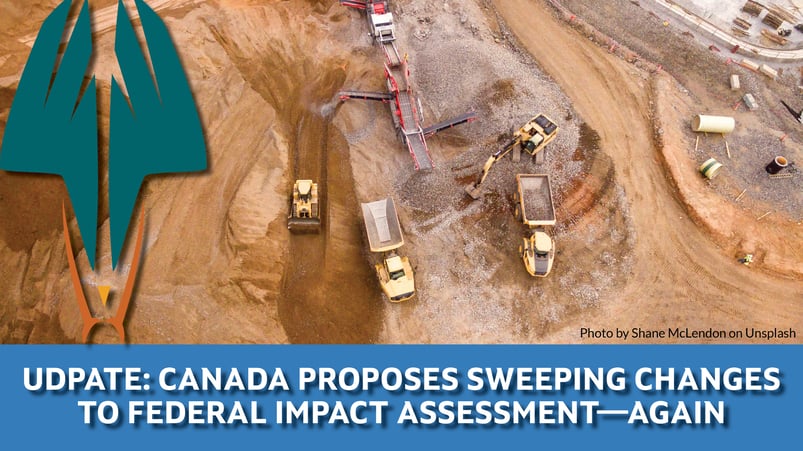
Changes that are being proposed
In the recently released discussion paper, Canada is proposing broader, more sweeping changes to the Impact Assessment Act and policy for all projects requiring a federal impact assessment. In other words, these changes would go beyond those in Bill C-5 for the narrower list of designated projects of national interest under the Building Canada Act.
Canada is now proposing the following structural changes:
- Federal review and decision-making on a timeline of no more than one year for all impact assessments of designated projects. The federal government is proposing that its review and decision-making take no more than one year. The proposal would run federal impact assessment and permitting processes concurrently, while proponents would have one year to submit their finalized studies and information.
- One Crown consultation process through the creation of what is being called a Crown Consultation Hub within the Impact Assessment Agency of Canada. The proposed hub would coordinate federal consultation so that each Indigenous community affected by a major project would participate in one coordinated federal consultation process, rather than multiple overlapping processes.
- One project decision, where the Minister of Environment, Conservation and Nature would issue both an impact assessment decision and a decision on all federal permits and authorizations at the same time.
- A single project authority, where impact assessments for designated projects under the Canada Energy Regulator (major pipelines and transmission lines), and the Canadian Nuclear Safety Commission (nuclear projects, nuclear waste disposal, and uranium mines) would be led by those independent agencies, and not by the Impact Assessment Agency of Canada.
- Enable the creation of economic zones through regional impact assessments, where the federal government could pre-approve certain developments, subject to conditions, potentially reducing or eliminating the need for separate project reviews. Examples of federal economic zones are: transportation corridors, telecommunications networks, energy production and transmission, and industrial regions.
- Streamlined regulatory environment, involving a longer list of changes on how decisions will be made, and giving federal decision-makers new powers to change or downgrade project conditions of approval or exempt projects from certain permits or other requirements.
Updates since the Discussion Paper
Since the discussion paper engagement period closed, federal and provincial governments have developed legislative approvals and frameworks at the federal and provincial levels to streamline project approvals:
1. The One Canadian Economy: An Act to enact the Free Trade and Labour Mobility in Canada Act and the Building Canada Act, known as Bill C-5, received royal assent. Currently, the federal Major Projects Office is supporting 16 projects and 7 transformative strategies, while the government continues the process of identifying projects that could be designated as being in the national interest under the Building Canada Act.
2. Impact Assessment Agency of Canada Forward Regulatory Plan, 2026 – 2028 will include the advancement of the following regulatory initiatives with input from consultation and engagement:
- Proposed cost recovery regulations include updating regulations to allow the Impact Assessment Agency of Canada to better recover costs incurred from the start to the end of an impact assessment process (from the initial Project Description to the completion of monitoring and follow-up).
- Proposed Indigenous impact assessment co-administration agreement regulations would allow the Minister of Environment and Climate Change to enter into agreements or arrangements with Indigenous governing bodies to:
- Give Indigenous governments jurisdiction for the application of the Impact Assessment Act
- Provide Indigenous governing bodies with authority to exercise power and perform duties or functions in relation to impact assessment on specified lands - Proposed administrative fines for violations under the Impact Assessment Act would aim to improve environmental protection by creating a flexible tool that uses financial penalties to supplement current enforcement measures imposed for violating environmental legislation.
- Proposed amendments to the Physical Activities Regulations, also known as the Project List, which describes the classes of “designated projects” that are subject to the Impact Assessment Act. This regulation was first introduced in 2019 with the Impact Assessment Act and is required to be reviewed every five years. The review took place in 2024 and is continuing to inform potential regulatory changes.
struck with provinces and the Impact Assessment Agency of Canada in the last year. This has put more emphasis on provincial environmental assessment processes being recognized as doing the equivalent work of a federal impact assessment for a major project. This approach recognizes provincial jurisdiction under the Constitution and is intended to avoid duplication where both a province and Canada undertake separate assessments. The rules guiding these agreements are laid out in the Impact Assessment Act. So far, agreements have been made with the following provinces:
- Alberta
- British Columbia
- Manitoba
- New Brunswick
- Nova Scotia
- Ontario
- Prince Edward Island
Shared Value Solutions is concerned that this approach could reduce opportunities for Indigenous Nations to engage directly with the federal government where a provincial process is substituted for, or carries out much of the work of, a federal assessment. This may be particularly significant where a province’s assessment process does not provide the level of support, participation, or accommodation that an Indigenous Nation considers necessary to address its interests and concerns.
In addition, Canada has recently signed the following related agreements with British Columbia and Alberta:
- The Canada-British Columbia Cooperative Prosperity Agreement
focuses on accelerating the construction of major energy projects and trade corridors, including new ports, and corresponding job creation and workforce readiness efforts. It also strengthens Canada’s commitments to protect and preserve the lands and waters through national initiatives such as the Whales Initiative, the Oceans Protection Plan, and a new national carbon credit framework,
 - The Alberta-Canada Memorandum of Understanding addresses shared aspirations and commitments toward Canada becoming a global energy leader, in part by advancing Alberta’s energy resources, while also continuing to work toward Canada’s net-zero greenhouse gas emissions objective. An implementation agreement has now been made public with additional details about carbon markets, electricity, the emissions-reducing Pathways Projects, an oil pipeline to global markets, and continued cooperation between the two parties.
4. Several provinces have been streamlining their own permitting and project review processes: Ontario, through the Building a More Competitive Economy Act, is implementing changes intended to streamline 13 natural resource permits to allow mining and infrastructure projects to move ahead faster with greater certainty. Included are fish and wildlife and forestry-related permits, along with permits to strengthen public lands management. This comes after the controversial Protect Ontario by Unleashing our Economy Act 2025, also known as Bill 5, led to the amendment of several of the province’s environmental acts.
British Columbia has previously introduced streamlining measures for approval of renewable energy projects including wind energy, solar energy, and transmission lines under the Renewable Energy Projects (Streamlined Permitting) Act. New infrastructure projects will also be streamlined through the Renewable Energy Projects (Streamlining Permitting) Act, which will speed up reviews related to permitting, environmental assessments, local planning, and agreements for provincially significant projects.
 Concerns about the proposed changes
Canada insists that these changes will not affect the duty to consult Indigenous Peoples, nor jurisdictions where Indigenous co-decision-making is required such as the Northwest Territories. It is possible that Indigenous governments who already have strong capacity, industry partnerships, and decision-making systems may actually benefit from some or all of these changes (a reason we’ve been blogging lately about the importance of major project readiness).
At SVS, we are concerned about how these changes may affect not only environmental protection, but also undermine the conditions that have allowed strong and meaningful Indigenous accommodation measures and even consent for development, through measures such as impact-benefit agreements. Along with Indigenous communities, Canada and proponents have benefited from the legal and contractual certainty that such agreements and protections provide.
Concerned about your Nation’s readiness to deal with streamlined project approvals?
Shared Value Solutions can help
If you need support, we are here to help! Contact us at info@sharedvaluesolutions.com / 226-706-8888 for more information. Read our recent blog posts to learn strategies for preparing your Nation:
- MAJOR PROJECT AND TIGHT TIMELINES- ARE YOU READY?
- Major Projects and Tight Timelines- How to Pick a Consultant That's Right for You
About the authors:

Scott Mackay MSc, RPP
Partner and Senior Consultant
Learn more about Scott here.

Meaghan Luis, MSc Pl RPP
Senior Environmental Assessment and Negotiations Specialist
Learn more about Meaghan here.

Meghan Dalrymple, MA
Senior Environmental Assessment Specialist
Learn more about Meghan here.

Annabelle Farrell, BASc
Junior Consultant
Learn more about Annabelle here.